
Yulia Sandamirskaya
Zurich Univversity for Applied Sciences
ICRA workshop
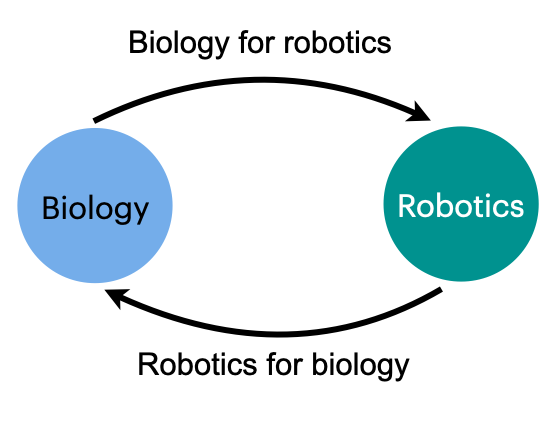
Progress in understanding collective animal behavior and in designing bio-inspired robotic systems increasingly depends on reciprocal studies that bridge biology and robotics. Biology has long inspired robotic design—providing principles of locomotion, sensing, and control that have led to powerful robotic models and experimental platforms. Yet, to fully unlock the potential of this synergy, we must equally strengthen the reverse direction: using robotic technologies as precise, controllable tools to probe biological systems. Robots can act as interactive stimuli and experimental agents, allowing us to test hypotheses about animal decision-making, social interactions, and the role of environmental forces under conditions that are difficult or impossible to achieve with live animals alone. Such robotics-for-biology approaches enable new insights into fundamental questions—from how fish sense and respond to hydrodynamic cues to how collective decisions emerge in large animal groups. This workshop will showcase recent advances in both directions of this exchange. We will highlight not only how biological principles continue to inspire novel robotic solutions, but also how the next generation of robotic platforms can serve as experimental instruments to drive biological discovery. By strengthening this two-way dialogue, we aim to accelerate progress in both fields and open new avenues for understanding complex collective behaviors.
Zurich Univversity for Applied Sciences

University of Michigan
CNRS

EPFL

MPI-AB

University of Florida

HKUST

University of Graz

Max-Planck Institute of Animal Behavior

University of Wisconsin-Madison

University of Michigan

University of Queensland

University of Freiburg

University of Wisconsin-Madison

University of Bern and University of Konstanz

University of Konstanz

University of Konstanz

MPI-AB and University of Konstanz